


 MENADEFENSE All about defense from Marrakech to Bengladesh

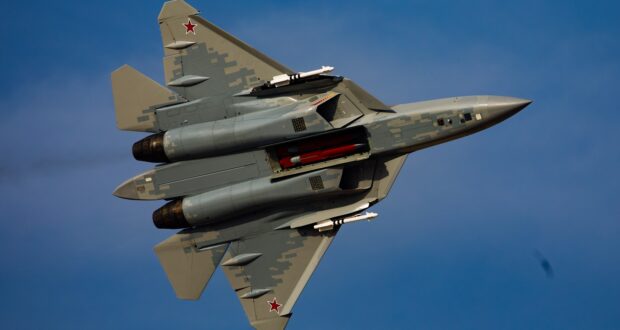
Russia’s state arms exporter is presenting the RVV-SDM as an extended-range evolution of the R-77/RVV-SD family. Its main advertised improvements include an active-passive radar seeker, enhanced resistance to electronic countermeasures and a slightly expanded low-altitude engagement envelope. Several critical performance figures, however, remain undisclosed.
Rosoboronexport announced on 29 July 2026 that it had launched a global marketing campaign for the RVV-SDM, a new medium-range air-to-air missile intended primarily for the export-oriented Su-57E fifth-generation fighter. The weapon was developed and is manufactured by Tactical Missiles Corporation, or KTRV, the parent organisation of Russia’s Vympel air-to-air missile design bureau.
According to the company, the RVV-SDM may also be adapted to other Russian-built aircraft and, following the required modifications, integrated into foreign-made combat aircraft. This indicates that Moscow intends to market the missile not only as part of the Su-57E weapons package, but potentially as an upgrade for existing fighter fleets.
The RVV-SDM is designed to engage combat aircraft, helicopters, cruise missiles and unmanned aerial vehicles by day or night and in a heavy electronic-countermeasures environment. Its guidance package combines an inertial navigation system, a radio-command update link and a new active-passive radar seeker. Rosoboronexport says it can engage targets flying at altitudes from 15 metres to 25 kilometres and at speeds of up to Mach 3. The Mach 3 figure refers to the maximum speed of the target, not the missile’s own velocity.
Active-passive seeker is the most significant change
The addition of a passive radar channel is the clearest identified improvement over the earlier RVV-SD. In active mode, the missile uses its own radar transmitter to acquire and track the target during the terminal phase. In passive mode, it can operate without transmitting and exploit electromagnetic emissions present in the engagement environment.
Rosoboronexport claims that the passive channel provides a more discreet attack, improved guidance accuracy and increased resistance to jamming. It may also reduce the time available for the target to detect the missile seeker’s activation. The company has not disclosed whether the passive mode is designed primarily to track the target’s own radar emissions, home on jamming signals, or perform both functions.
The existing export-standard RVV-SD uses inertial guidance with radio mid-course updates and active radar homing during the terminal phase. Its officially published maximum launch range is 110 kilometres, compared with 80 kilometres for the earlier RVV-AE.
Greater than 110 kilometres, but by how much?
Rosoboronexport states that the RVV-SDM has a longer launch range but does not publish an exact figure. The press release also does not formally identify the missile against which the comparison is being made.
Given the RVV-SDM designation and its position as an evolution of the RVV-SD family, it is reasonable to infer that its claimed maximum range exceeds the RVV-SD’s published 110-kilometre figure. This remains an inference, however: no verified range greater than 110 kilometres has been officially released for the RVV-SDM.
The company also refers to a higher thrust-to-weight ratio and improved aerodynamic performance. These changes could allow the missile to retain more energy during the terminal phase and increase its effective engagement zone against manoeuvring targets. Rosoboronexport has not disclosed the motor type, number of propulsion pulses, maximum missile speed or powered-flight duration.
Slightly expanded low-altitude envelope
The RVV-SDM is officially credited with the ability to engage targets flying as low as 15 metres, compared with 20 metres for the RVV-AE and RVV-SD. While the five-metre difference may appear modest, it could be relevant when intercepting sea-skimming cruise missiles or low-flying unmanned aircraft.
The upper engagement altitude remains 25 kilometres. The ability to engage targets travelling at up to Mach 3 is not necessarily new: Rosoboronexport previously stated that the RVV-AE could intercept targets flying at up to 3,600 km/h. Target speed alone should therefore not be regarded as a major generational improvement.
Designed around the Su-57E weapons package
The RVV-SDM joins the short-range RVV-MD2 and long-range RVV-BD in the air-to-air weapons package offered with the Su-57E. Other export weapons listed for the aircraft include the Kh-38MLE air-to-surface missile, the low-observable Kh-69 cruise missile, the Kh-58UShKE anti-radiation missile, the Kh-35UE anti-ship missile and several guided bombs.
These weapons can be carried internally to preserve the aircraft’s reduced radar signature or externally when a larger payload is required. The absence of published RVV-SDM dimensions and weight makes it impossible to determine whether the missile retains the exact RVV-SD airframe or uses a body more extensively optimised for the Su-57’s internal weapons bays. Publicly presented Su-57 configurations provide space for up to four missiles in the main internal bays and two additional weapons in the lateral bays.
Combat claims remain difficult to assess
Rosoboronexport says that the RVV-SDM has already been used by the Su-57 under actual combat conditions and in the presence of advanced air-defence and electronic-warfare systems. The release provides no dates, engagement records, test conditions, success rates or independently verifiable evidence supporting these claims. They should therefore be reported as manufacturer statements rather than independently confirmed performance data.
The RVV-SDM nevertheless represents a potentially significant development in Russia’s export air-to-air missile portfolio. Its active-passive seeker and claimed range increase could strengthen the Su-57E’s beyond-visual-range capability in heavily contested electromagnetic environments. A comprehensive assessment will remain impossible until Russia publishes its precise range, dimensions, launch weight, propulsion arrangement, warhead and seeker characteristics.
Known technical specifications
| Specification | RVV-SDM |
|---|---|
| Category | Medium-range air-to-air missile |
| Manufacturer | Tactical Missiles Corporation/KTRV |
| Primary platform | Su-57E |
| Other platforms | Modified Russian aircraft and potential foreign-aircraft integration |
| Intended targets | Aircraft, helicopters, cruise missiles and UAVs |
| Guidance | Inertial navigation, radio updates and active-passive radar seeker |
| Target-altitude envelope | 15 m to 25 km |
| Maximum target speed | Up to Mach 3 |
| Maximum launch range | Longer than the RVV-SD according to the manufacturer; exact figure undisclosed |
| Propulsion | Undisclosed; improved thrust-to-weight ratio claimed |
| Warhead | Undisclosed |
| Launch weight | Undisclosed |
| Dimensions | Undisclosed |
| Missile speed | Undisclosed |
| Maximum manoeuvrability | Undisclosed |
| Employment mode | Claimed fire-and-forget capability |
| Electronic protection | Passive channel and improved jamming resistance claimed |
Main differences from earlier versions
| Specification | RVV-AE | RVV-SD | RVV-SDM |
|---|---|---|---|
| Published maximum range | 80 km | 110 km | Undisclosed; described as increased |
| Minimum target altitude | 20 m | 20 m | 15 m |
| Maximum target altitude | 25 km | 25 km | 25 km |
| Terminal seeker | Active radar | Active radar | Active-passive radar |
| Launch weight | 175 kg | 190 kg | Undisclosed |
| Warhead weight | 22.5 kg | 22.5 kg | Undisclosed |
| Length | 3.60 m | 3.71 m | Undisclosed |
| Diameter | 200 mm | 200 mm | Undisclosed |
| Mid-course updates | Radio correction | Radio correction | Radio correction |
| Aerodynamics/thrust-to-weight | Original configuration | Improved over RVV-AE | Further improvement claimed |
The earlier missile figures are drawn from official Russian export catalogues



 Loading ...
Commentaires Recents